











Linux and open source have revolutionized the way we use and develop software. They stand for flexible, customizable platforms and foster a vibrant community that shares knowledge and drives innovation. In this article, we highlight the reasons why we particularly value Linux and open source—from freedom of customization to global collaboration.
What is open source?
Open source describes software whose source code is publicly available. This means that anyone can view, modify, and distribute the code—provided they comply with the relevant open source license (of which there are now hundreds, e.g., GPL, MIT, or Apache). This openness promotes innovation, transparency, and collaboration, creating an active community of developers and users who work together to improve the software.
Open source is more than just a licensing issue—it is a philosophy that emphasizes freedom, control, and collaborative work.
The history of Linux
Linux is the best-known open source operating system, created in 1991 by Linus Torvalds. Originally intended as a personal challenge, Linux quickly developed into one of the most significant projects in software history. The idea of creating a free and open operating system revolutionized the IT world and now forms the basis for numerous modern technologies.
The advantages of Linux and open source
cost efficiency
One major advantage of open source software such as Linux is its cost efficiency. Companies do not have to pay high license fees, but can download and customize the software free of charge. This gives small and medium-sized enterprises in particular access to high-quality technologies that they might otherwise not be able to use.
Flexibility and adaptability
Linux and open source offer unparalleled flexibility. Companies can adapt the software to their specific needs, which is particularly important given that technology requirements are constantly changing. The ability to edit the source code ensures that the software is optimally tailored to the respective processes and requirements.
Safety and stability
Another advantage of open source software is security. Since the source code is publicly available, developers and security researchers can identify and fix vulnerabilities. This often leads to faster security updates and more stable software. Linux is known for its robustness and is often used in critical applications where downtime can be costly.
Community and support
The open source community is a strong and dedicated group. Developers from all over the world work together to solve problems and share knowledge. This collaboration leads to a constantly growing and improving software landscape. Users benefit from a wide range of resources, tutorials, and forums that make it easier to get started with Linux and other open source software.
Linux in business: A model of success
More and more companies are using Linux—whether as a server operating system, container platform, or cloud base. The reasons are obvious: flexibility, security, scalability, and a strong cost structure make Linux the preferred choice in modern IT architectures.
Cloud providers such as AWS, Google Cloud, and Azure natively support Linux, which facilitates integration into existing DevOps or hybrid cloud strategies.
The challenges of open source
Despite its many advantages, open source also presents challenges:
- Technical know-how: Adapting open source software requires expertise. Training and specialist knowledge are necessary to exploit its full potential.
- Support options: While community support is valuable, it is not always sufficient. Companies must decide whether to rely on internal resources or seek professional support.
We love open source – An overview of our open source solutions
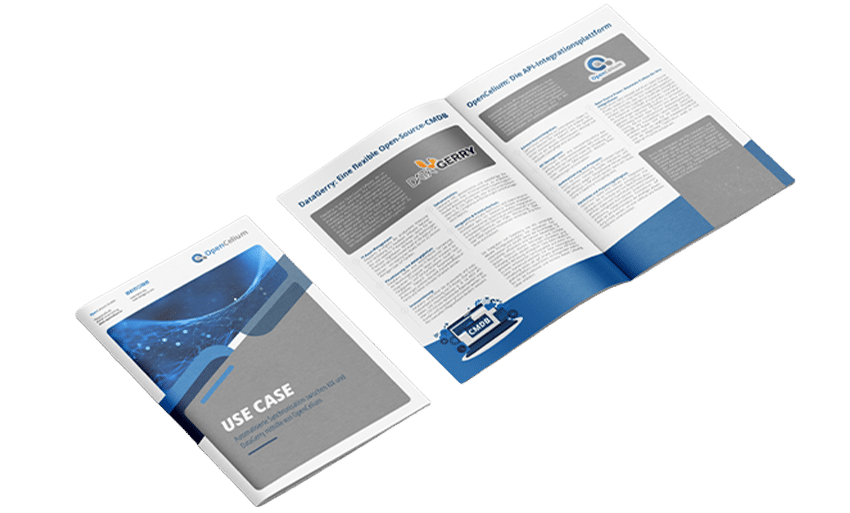
OpenCelium – The API Integration Platform
OpenCelium is an open-source API management system that specializes in the systematic management, monitoring, and automation of API interfaces. With its intuitive user interface, it enables the central connection of a wide variety of systems and applications—from ticketing tools and monitoring systems to identity management solutions. Predefined connectors and business templates allow IT processes to be efficiently digitized and data exchange between applications to be automated. Especially in conjunction with solutions such as i-doit or DataGerry, OpenCelium unleashes its full potential as an integration hub – ideal for companies that want to build an agile and secure IT infrastructure.

DataGerry – The flexible open source CMDB for customized IT structures
DataGerry is a modern, highly customizable open source CMDB that enables companies to define their data models entirely on their own. Unlike many other solutions, DataGerry does not use rigid, predefined object types, but instead allows users to develop their own structures for mapping the IT landscape. Thanks to powerful APIs and event triggers, data can be automatically synchronized with other tools such as OpenCelium, i-doit, or monitoring systems. This makes DataGerry the central source of information for IT asset management, server administration, network infrastructure, and IPAM—an essential tool for companies that rely on dynamic IT processes.

Wazuh – Open source SIEM and XDR platform for comprehensive security
Wazuh combines functions such as host intrusion detection, centralized log analysis, vulnerability management, and real-time threat detection in a single platform. As a powerful SIEM (Security Information and Event Management) solution, Wazuh offers comprehensive transparency into security-related events in networks and endpoints—whether on-premises or in the cloud. Especially in combination with i-doit and its ISMS add-on, Wazuh is the ideal solution for companies seeking ISO27001 certification. With Wazuh, compliance requirements can be efficiently implemented, security gaps proactively identified, and IT risks minimized in the long term.

KIX Service Software – Smart service processes through open source ITSM
As an open source ITSM solution, KIX Service Software offers comprehensive functions for managing incidents, assets, changes, and workflows. With customizable modules, automation options, and an intuitive interface, KIX is suitable for companies of all sizes that want to improve their service quality in the long term. Seamless integration into existing infrastructures—such as with i-doit for asset data or OpenCelium for API-supported automation—makes KIX a future-proof platform for holistic IT service management. Particularly noteworthy is the scalability of KIX, which is suitable for both small teams and large organizations.

i-doit – The established open source CMDB with potential for expansion
i-doit is a widely used open source CMDB that was developed specifically for documentation-based IT environments. As a Best Performing Partner, becon GmbH offers comprehensive support and customized developments and is an official Premium Partner of i-doit. The solution can be flexibly expanded with numerous add-ons, such as ISMS for information security management. i-doit impresses with its strong community, broad user base, and the ability to efficiently map and manage complex IT infrastructures.

Conclusion
The appeal of Linux and open source extends beyond software and reflects a deeper philosophy: technology should be accessible and adaptable for everyone. Open source solutions offer the flexibility and innovation that businesses need to succeed.
With a focus on customized software solutions, becon leverages the strengths of open source to implement sustainable, powerful, and economically viable systems. We stand for openness, innovation, and collaborative partnerships.
Our experts actively participate in open source projects, continuously expand their knowledge, and provide comprehensive consulting services to companies—from strategy to technical implementation. We also offer targeted workshops and training courses to facilitate the transition to Linux and open source and build internal expertise.
becon blog
More articles on this topic
Contact
Get in touch with us!
We look forward to hearing from you.
Do you have any questions or are you facing a particular challenge? Our dedicated team will be happy to provide you with a no-obligation consultation.